
Early childhood, primary and secondary education
Our schools are in crisis. Over many years, state and federal governments, both Labor and Liberal, have refused to put in the required resources. Victoria's state Labor government still spends less per student in government schools than any other state or territory. The ‘Gonski reforms’ promised increased equity but have instead delivered record funding to elite private schools to build orchestra pits, Olympic-sized swimming pools and wellness centres. Victorian Socialists oppose private education as a matter of principle: every child deserves a high quality of education regardless of their parents' wealth.
Teachers also have a crushing administrative burden which adds little or nothing to educational outcomes and student welfare. The national curriculum is determined by a small group of elite bureaucrats and representatives of the private schools lobby with educators and their unions excluded from the process. It is regularly used by politicians to fight right wing culture wars. The result is schools in which the professional expertise of staff is sidelined and teachers don't get the time they need to plan classes, evaluate student learning or spend extra time supporting students.
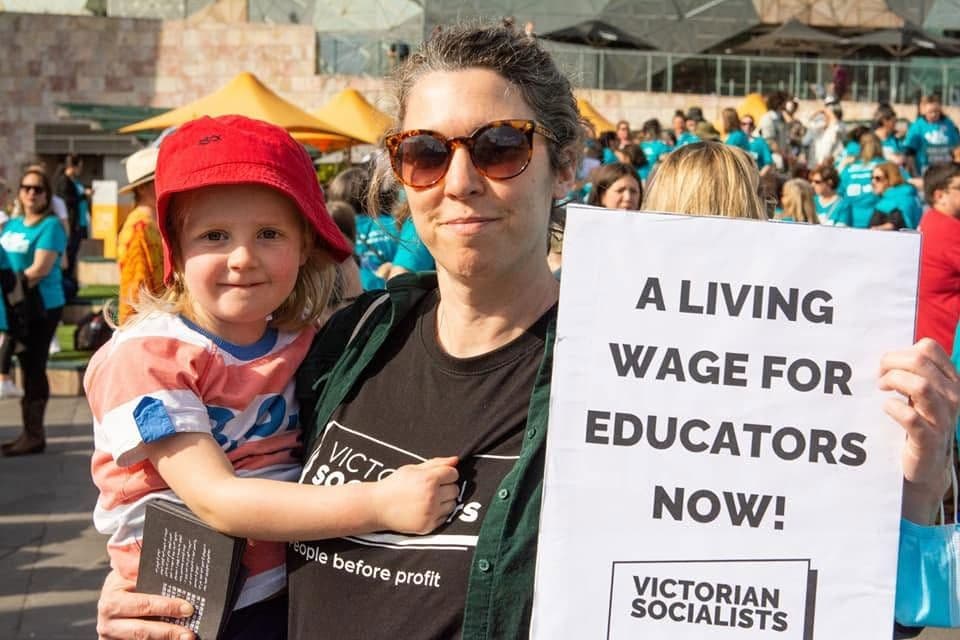
The early learning and care system in Australia has become an example of the worst impacts of privatisation. Workers are grossly underpaid relative to their skills while multinational corporations reap profits — all paid for through the taxes of workers. The drive for profit drives down staffing ratios, pay and conditions which directly impacts the quality of education and care. Abuse of children is responded to with surveillance cameras and increased administrative burden for already overworked educators.
Our education system is unfair for students, for teachers and for communities. We need a radical shift, in funding and in power, to address the crisis.
What we think
- Governments have a responsibility to provide high-quality and comprehensive public education for all; no child is more deserving, or less deserving, of a quality education than any other child. The level of resources for a child’s education should not be determined by the wealth of the child’s parents.
- Access to quality early childhood education is a key foundation of a child’s social, emotional and cognitive development.
- State education, including early years education and care, must be free.
- Funding to schools must be on the basis of need.
- School staff working conditions are students’ learning conditions: work in schools should be recognised for its complexity and the professional expertise of educators should be paid accordingly.
- The curriculum must be determined by teachers, students and communities, and must serve the needs of students.
- Teachers must have control of their own classroom practice.
- Community control of the education of Aboriginal children can and must be accommodated within a well supported public education system.
We’ll fight to
End privatisation and fund public education
- Immediately cease state funding to high fee private schools.
- Immediately implement Trevor Cobbold's "Gonski-plus" model as a minimum for spending on public schools.
- Work with low fee private schools to transition to the public system.
- Fund the full cost of an education including excursions, buildings, maintenance, devices and uniforms. End so-called "voluntary contributions" from parents in state schools.
- Provide free nutritious lunches for all primary school children in government schools.
- Expand the network of state-run early learning and childcare centres by 3,200, prioritising rollout in areas of greatest need and lowest existing service access, so that all Victorian children have access to a state-run early learning and care centre.
Provide high quality education
- Reduce class sizes to a maximum of 15 (currently 25 in secondary, average of 26 in primary, average of 21 in P-2).
- Hire 12,000 additional teachers and support staff for the state’s 1,600 public schools, allocated on the basis of need including administrators, counsellors, educational psychologists, nurses, doctors, lawyers, disability workers, youth workers and social workers.
- Provide schools with the necessary specialist staff and facilities to properly cater for the needs of students with disabilities.
- Require all public schools to have a school library staffed by a qualified librarian.
- Provide additional funding for supported playgroups, parenting support programs and early language development.
Support education workers
- Fully fund the AEU log of claims in the 2026 Victorian Government Schools Agreement.
- Recognise early childhood education workers as part of the education workforce, paid at the same rates as primary and secondary school educators and with comparable conditions.
- Pay teachers and education staff for all overtime performed.
- Make all school staff including cleaners and casual relief teachers employees of the Department of Education and abolish the use of labour hire firms for casual staff.
Make schools work for students and communities
- Abolish VCE and replace it with holistic strengths-based curriculum and assessment.
- Provide Aboriginal and community language programs in all schools.
- Allow communities to control the governance of their local schools and early learning and care centres, led by teachers, workers, students and local communities, not vested interests and faceless bureaucrats.
- Allow school staff to inform the management of school resources to maximise the benefits for students, including deciding on the balance between new teachers and support staff, making decisions about class sizes, whether and how streaming should occur, and allocating resources to deal with welfare and behavioural issues.
- Provide additional resources to support First Nations and other marginalised communities to govern their local schools.